Random Country Generator 🌎

Myanmar
🏙️ Capital city:
Naypyidaw
📈 Country population:
55 million
🗺️ Country area:
676,578 km²
Core Facts / Infobox
Present this as a clean two-column table containing accurate and verified national facts. Include only fields with real data.
| Official Name | Republic of the Union of Myanmar |
| Common Name | Myanmar (Burma) |
| ISO Codes | MM, MMR, 104 |
| Internet TLD | .mm |
| Calling Code | +95 |
| Capital City | Naypyidaw |
| Largest City | Yangon |
| Coordinates | 22° N, 98° E |
| Time Zone | UTC+6:30 |
| Population (2025 est.) | ~55 million |
| Area | 676,578 km² |
| Population Density | ~82 per km² |
| Languages | Burmese (official), plus many ethnic languages |
| Currency | Myanmar Kyat (MMK) |
| Driving Side | Right |
| GDP (Nominal) | ~USD 65 billion |
| GDP (PPP) | ~USD 270 billion |
| GDP Per Capita | ~USD 1,200 |
| GDP Growth | Varies due to political instability |
| HDI | 0.585 (Medium) |
| Literacy Rate | ~90% |
| Life Expectancy | ~68 years |
| Unemployment | ~2–3% |
| Inflation | High and fluctuating |
| Leaders | President & State Administration Council (subject to political changes) |
| Continent & Subregion | Asia — Southeast Asia |
| National Day | 4 January (Independence Day) |
| National Sport | Chinlone |
| National Dish | Mohinga |
| National Anthem | Kaba Ma Kyei |
Geography & Environment
- Myanmar is located in Southeast Asia, bordered by India, Bangladesh, China, Laos, and Thailand.
- It has diverse landscapes including mountains, river deltas, rainforests, and long coastlines along the Bay of Bengal and Andaman Sea.
- Major geographic features include the Irrawaddy River, Shan Plateau, Rakhine Mountains, and tropical coastlines.
- Climate: tropical monsoon with hot, rainy, and cool seasons.
- Best time to visit: November to February.
- Important national parks: Hkakabo Razi, Alaungdaw Kathapa, Lampi Marine National Park.
- Rich biodiversity includes elephants, tigers, leopards, gibbons, and rare birds.
- Environmental challenges: deforestation, flooding, habitat loss, and climate-related disasters.
- Unique natural attractions include Inle Lake and Hkakabo Razi (Myanmar’s highest peak).
Demographics
- Total population: ~55 million.
- Median age: ~30 years.
- Urban vs rural: ~31% urban, ~69% rural.
- Ethnic diversity includes Bamar majority and 135+ recognized ethnic groups such as Shan, Karen, Rakhine, Chin, Kachin, and Mon.
- Main religions: Buddhism (majority), Christianity, Islam, and animist traditions.
- Literacy rate: ~90%.
- Major cities: Yangon, Mandalay, Naypyidaw, Mawlamyine, Bago.
History
- Myanmar has ancient roots with early kingdoms like Pagan, Ava, Toungoo, and Konbaung.
- It became a British colony in the 19th century, known as Burma.
- Myanmar gained independence on 4 January 1948.
- The country has experienced military rule for decades, with brief democratic openings.
- Recent years have seen political instability, conflicts, and ongoing reform efforts.
- Myanmar’s rich cultural heritage includes Buddhist temples, royal cities, and unique ethnic traditions.
Government & Politics
- Government type: mixed system with strong military influence.
- Executive power is shared between elected leaders and the military council.
- Legislature: historically bicameral but currently impacted by political transitions.
- Judiciary: Supreme Court and regional courts.
- Administrative divisions: 7 states, 7 regions, Union Territory, and special zones.
- Key political issues include federalism, ethnic autonomy, peace negotiations, and economic reforms.
Economy
- Myanmar’s economy is developing but impacted by political uncertainty.
- Major industries: agriculture, energy, mining, manufacturing, forestry, and tourism.
- Main exports: natural gas, rice, beans, jade, timber, garments, minerals.
- Main imports: fuel, machinery, vehicles, electronics, food products.
- Strengths: natural resources, young workforce, strategic location.
- Weaknesses: infrastructure challenges, sanctions, currency volatility, political instability.
- GDP sectors: Agriculture (~22%), Industry (~35%), Services (~43%).
Culture & Society
- Myanmar has a deep cultural heritage influenced by Buddhism, ethnic traditions, and ancient kingdoms.
- Traditional values emphasize respect, modesty, hospitality, and community.
- Major festivals: Thingyan Water Festival (New Year), Thadingyut Festival of Lights, Tazaungdaing.
- Traditional dress: Longyi for men and women.
- Arts include puppet theater, lacquerware, wood carving, and classical Buddhist architecture.
- Main languages include Burmese, Shan, Karen, Rakhine, Mon, and many others.
Food & Cuisine
- National dish: Mohinga (rice noodle fish soup).
- Other iconic dishes: Tea Leaf Salad (Laphet Thoke), Shan Noodles, Burmese Curry, Nan Gyi Thoke.
- Street foods: samosas, skewers, noodles, fried snacks.
- Beverages: milk tea, palm wine, green tea.
- Cuisine blends Indian, Chinese, Thai, and local flavors.
Education & Institutions
- Education is improving but faces challenges in rural areas.
- Medium of instruction: Burmese; English is taught widely.
- Literacy rate: ~90%.
- Top universities: University of Yangon, Mandalay University, Yangon Technological University.
- Strengths: social sciences, engineering, religious studies.
Tourism
- Top destinations: Bagan, Yangon, Mandalay, Inle Lake, Naypyidaw, Ngapali Beach.
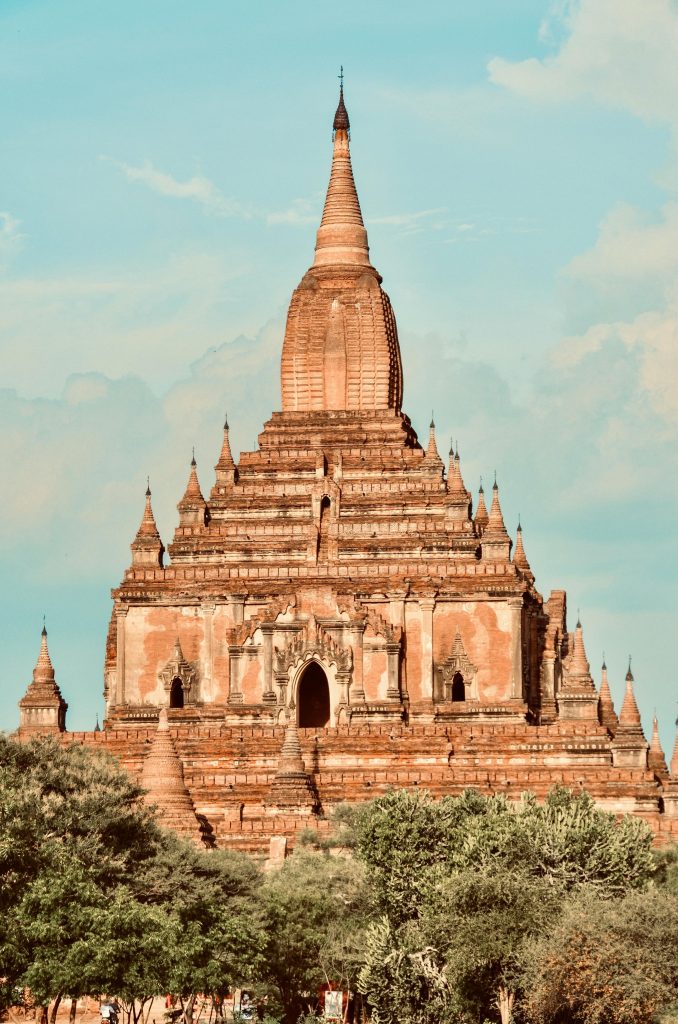
- UNESCO World Heritage Sites: Bagan, Pyu Ancient Cities.
- Natural attractions: Inle Lake, Shan Hills, Irrawaddy River, pristine beaches.
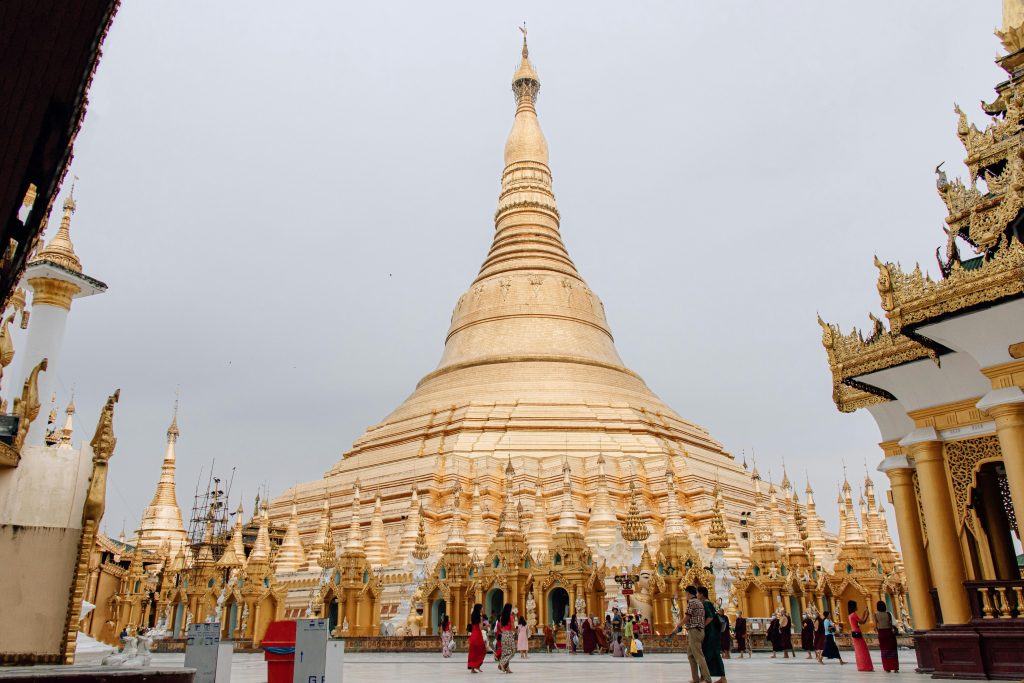
- Historical landmarks: Shwedagon Pagoda, Mandalay Palace, ancient temples of Bagan.
- Adventure tourism: trekking in Kalaw, river cruises, hot air balloon rides.
- Visa: e-visa available for many countries.
- Transportation: buses, trains, domestic flights, boats, taxis.
Practical Information
- Safety: varies by region due to political conflicts; major cities generally safer.
- Healthcare: limited outside major cities.
- Emergency numbers: Police 199, Ambulance 192.
- Plug type: C, D, F; Voltage: 230V.
- Internet: improving but inconsistent in rural areas.
- Best time to visit: November–February.
- Budget: affordable for travelers.
Sports, Entertainment & Notable People
- National sport: Chinlone.
- Popular sports: football, boxing, martial arts.
- Notable people: Aung San, U Thant, Khin Nyunt, Ludu Daw Amar.
- Traditional entertainment: marionette theater, dance, folk music.
Neighboring Countries of Myanmar
Myanmar shares land borders with the following countries:
- 270 km with Bangladesh
- 2,129 km with China
- 1,468 km with India
- 238 km with Laos
- 2,416 km with Thailand
Famous For
- Bagan temples and ancient Buddhist architecture.
- Shwedagon Pagoda in Yangon.
- Traditional culture and ethnic diversity.
- Inle Lake floating villages.
- Longyi clothing and tea leaf salad.
- Tropical beaches and natural beauty.
- Gold-covered pagodas and royal history.
Sources
- World Bank
- United Nations (UN Data)
- IMF
- CIA World Factbook
- Myanmar Central Statistical Organization
- Official Government Portals