
Random Country Generator 🌎
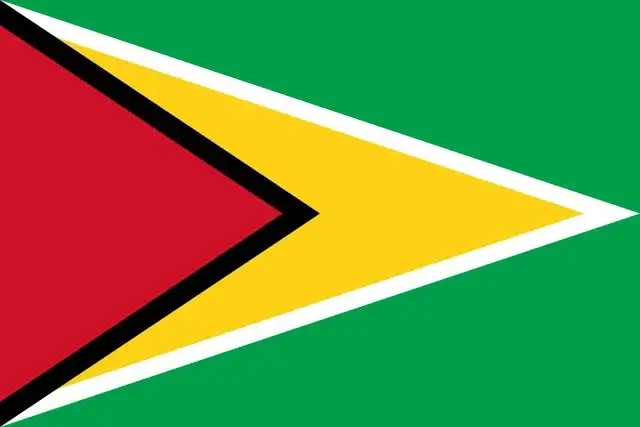
Guyana
🏙️ Capital city:
Georgetown
📈 Country population:
800,000
🗺️ Country area:
214,969 km²
Core Facts / Infobox
Present this as a clean two-column table containing accurate and verified national facts. Include only fields with real data.
| Official Name | Co-operative Republic of Guyana |
| Common Name | Guyana |
| ISO Codes | GY, GUY, 328 |
| Internet TLD | .gy |
| Calling Code | +592 |
| Capital City | Georgetown |
| Largest City | Georgetown |
| Coordinates | 6.8° N, 58.2° W |
| Time Zone | UTC−4 |
| Population (2025 est.) | ~800,000 |
| Area | 214,969 km² |
| Population Density | ~4 per km² |
| Languages | English (official), Guyanese Creole, Indigenous languages |
| Currency | Guyanese Dollar (GYD) |
| Driving Side | Left |
| GDP (Nominal) | ~USD 19+ billion |
| GDP (PPP) | ~USD 27+ billion |
| GDP Per Capita | ~USD 23,000+ (one of the fastest-growing globally) |
| GDP Growth | Extremely high due to oil sector expansion |
| HDI | 0.682 (Medium) |
| Literacy Rate | ~86% |
| Life Expectancy | ~70 years |
| Unemployment | ~12% |
| Inflation | Low to moderate |
| Leaders | President & Government Ministers (names omitted for longevity) |
| Continent & Subregion | South America — The Guianas, Caribbean region |
| National Day | 23 February (Republic Day) |
| National Sport | Cricket |
| National Dish | Pepperpot |
| National Anthem | Dear Land of Guyana, of Rivers and Plains |
Geography & Environment
- Guyana is located on the northern coast of South America, bordering Venezuela, Brazil, Suriname, and the Atlantic Ocean.
- Over 80% of the country is covered in dense rainforest, forming part of the Guiana Shield.
- Major natural features: Kaieteur Falls, Essequibo River, Kanuku Mountains, Pakaraima Highlands.
- Climate: tropical with wet and dry seasons; warm and humid year-round.
- Best time to visit: February–April and September–October.
- National parks: Kaieteur National Park, Iwokrama Forest, Shell Beach Protected Area.
- Wildlife: jaguars, giant otters, harpy eagles, capybaras, tapirs, and hundreds of bird species.
- Environmental challenges: deforestation, mining pollution, coastal erosion.
- Unique feature: One of the highest biodiversity densities in the world.
Demographics
- Population: ~800,000.
- Median age: ~27 years.
- Urban population: ~27% (Guyana is mostly rural).
- Ethnic groups: Indo-Guyanese, Afro-Guyanese, Indigenous Amerindians, mixed heritage, small Chinese and European communities.
- Religions: Christianity, Hinduism, Islam, Indigenous spiritual beliefs.
- Literacy rate: ~86%.
- Major cities: Georgetown, Linden, New Amsterdam, Anna Regina.
History
- Originally inhabited by Amerindian tribes such as Arawak and Carib peoples.
- Colonized by the Dutch in the 17th century, later controlled by the British.
- Known as British Guiana until independence.
- Gained independence on 26 May 1966 and became a republic on 23 February 1970.
- Modern history includes political shifts, economic struggles, and rapid transformation due to offshore oil discoveries.
Government & Politics
- Government type: Unitary presidential republic.
- Executive: President as head of state and government.
- Legislature: unicameral National Assembly.
- Judiciary: Supreme Court, Court of Appeal, High Court.
- Administrative divisions: 10 regions.
- Key issues: border dispute with Venezuela, oil governance, development planning, infrastructure expansion.
Economy
- One of the fastest-growing economies in the world due to massive offshore oil reserves.
- Major industries: oil & gas, gold mining, bauxite, agriculture (rice, sugar), forestry, fishing.
- Main exports: crude oil, gold, rice, sugar, bauxite.
- Main imports: machinery, fuel, consumer goods, food products.
- Strengths: oil wealth, natural resources, strategic partnerships.
- Weaknesses: income inequality, infrastructure challenges, vulnerability to political instability.
- GDP sectors: Industry (oil-heavy) ~60%, Services ~30%, Agriculture ~10%.
- Guyana’s oil boom is transforming it into a high-income economy trajectory.
Culture & Society
- A multicultural society with African, Indian, Indigenous, Chinese, and European influences.
- Important festivals: Mashramani, Diwali, Phagwah (Holi), Eid, Christmas.
- Traditional dress varies by ethnic group; Amerindian attire used during cultural events.
- Music: chutney, soca, reggae, calypso, folk drumming.
- Languages: English (official), Guyanese Creole widely spoken.
Food & Cuisine
- National dish: Pepperpot — a slow-cooked stew with cassareep, cinnamon, and meat.
- Popular dishes: Cook-up rice, Roti & Curry, Metemgee, Bake & Saltfish.
- Street foods: egg balls, pholourie, chow mein (Chinese-Guyanese influence).
- Beverages: mauby, sorrel drink, rum, peanut punch.
- Cuisine reflects rich African, Indian, Caribbean, and Indigenous traditions.
Education & Institutions
- Medium of instruction: English.
- Literacy rate: ~86%.
- Top institutions: University of Guyana, Guyana School of Agriculture.
- Strong fields: agriculture, medicine, environmental sciences, mining engineering.
Tourism
- Top attractions: Kaieteur Falls, Iwokrama Rainforest, St. George’s Cathedral, Shell Beach, Rupununi Savannah.
- UNESCO: Guiana Shield ecosystems (recognized regionally).
- Natural attractions: waterfalls, rainforest treks, wildlife reserves.
- Historical landmarks: Fort Zeelandia, old Dutch and British colonial sites.
- Adventure tourism: river expeditions, birdwatching, mountain hikes.
- Visa: varies by nationality; many countries enjoy visa-free access.
- Transportation: minibuses, taxis, river boats, limited domestic flights.
Practical Information
- Safety: varies; caution advised in urban areas.
- Healthcare: improving; best services in Georgetown.
- Emergency numbers: Police 911, Fire 912, Ambulance 913.
- Plug type: A, B, & D; Voltage: 120/240V.
- Internet: available in major towns; limited in rural interior.
- Best time to visit: February–April and September–October.
- Budget: moderate; eco-tourism packages may be pricier.
Sports, Entertainment & Notable People
- National sport: cricket.
- Famous athletes: Shivnarine Chanderpaul, Carl Hooper, Aliann Pompey.
- Entertainment: calypso, chutney, Caribbean festivals.
- Notable figures: Walter Rodney (historian), Eddy Grant (musician), Forbes Burnham (political leader).
Neighboring Countries of Guyana
Guyana is located on the northeast coast of South America and borders three countries: Suriname to the east, Brazil to the south and southwest, and Venezuela to the west. To the north, it is bordered by the Atlantic Ocean.
Famous For
- Kaieteur Falls (one of the world’s highest single-drop waterfalls).
- Massive offshore oil discoveries.
- Dense Amazonian rainforest and rich biodiversity.
- Multicultural society and festivals.
- Amerindian heritage and eco-tourism.
- Wildlife such as jaguars, giant otters, and exotic birds.
Sources
- World Bank
- United Nations (UN Data)
- IMF
- CIA World Factbook
- Guyana Bureau of Statistics
- Official Government Publications