Random Country Generator 🌎

Nepal
🏙️ Capital city:
Kathmandu
📈 Country population:
31 million
🗺️ Country area:
147,516 km²
Core Facts / Infobox
Present this as a clean two-column table containing accurate and verified national facts. Include only fields with real data.
| Official Name | Federal Democratic Republic of Nepal |
| Common Name | Nepal |
| ISO Codes | NP, NPL, 524 |
| Internet TLD | .np |
| Calling Code | +977 |
| Capital City | Kathmandu |
| Largest City | Kathmandu |
| Coordinates | 28° N, 84° E |
| Time Zone | UTC+5:45 |
| Population (2025 est.) | ~31 million |
| Area | 147,516 km² |
| Population Density | ~210 per km² |
| Languages | Nepali (official), 120+ indigenous languages |
| Currency | Nepalese Rupee (NPR) |
| Driving Side | Left |
| GDP (Nominal) | ~USD 45 billion |
| GDP (PPP) | ~USD 110 billion |
| GDP Per Capita | ~USD 1,500+ |
| GDP Growth | ~4–6% |
| HDI | 0.602 (Medium) |
| Literacy Rate | ~71% |
| Life Expectancy | ~71 years |
| Unemployment | ~11–12% |
| Inflation | ~6–7% |
| Leaders | President & Prime Minister (names omitted for longevity) |
| Continent & Subregion | Asia — South Asia |
| National Day | 20 September (Constitution Day) |
| National Sport | Volleyball |
| National Dish | Dal Bhat |
| National Anthem | Sayaun Thunga Phool Ka |
Geography & Environment
- Nepal is a landlocked Himalayan country bordered by India to the south, east, and west, and China to the north.
- It contains diverse landscapes: the Himalayan mountains, mid-hills, valleys, and the Terai plains.
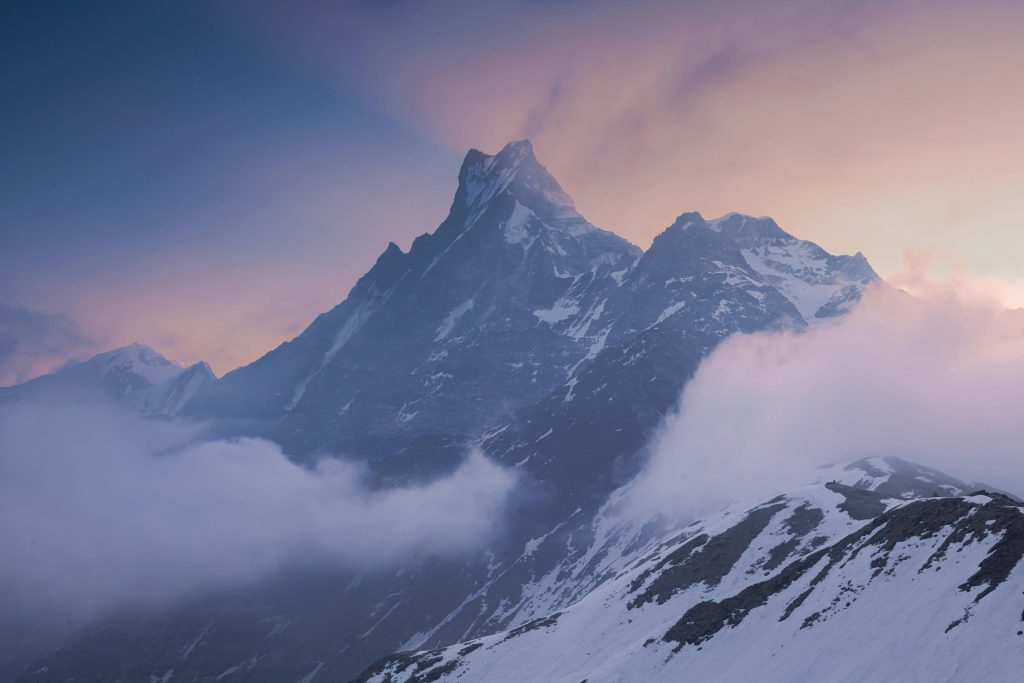
- Nepal is home to Mount Everest, the world’s highest peak, and eight of the world’s 14 highest mountains.
- Major rivers: Koshi, Gandaki, Karnali; many originate from the Himalayas.
- Climate ranges from tropical in the Terai to alpine in the high Himalayas.
- Best time to visit: March–May and September–November.
- National parks: Chitwan, Sagarmatha, Bardia, Langtang, Shivapuri.
- Wildlife includes tigers, rhinos, elephants, snow leopards, red pandas, and hundreds of bird species.
- Environmental challenges: deforestation, landslides, earthquakes, glacial melting.
- Unique features: Himalayas, deep valleys, terraced farms, and sacred pilgrimage sites.
Demographics
- Total population: ~31 million.
- Median age: ~25 years.
- Urban vs rural: ~65% rural, though urbanization is rising.
- Ethnic diversity: Chhetri, Brahmin, Magar, Tharu, Tamang, Newar, Rai, Gurung, and many more.
- Religions: Hinduism (majority), Buddhism, Islam, Christianity, Kirat.
- Literacy rate: ~71%.
- Major cities: Kathmandu, Pokhara, Lalitpur, Biratnagar, Bharatpur.
History
- Early Nepal was influenced by Indo-Aryan and Tibetan cultures.
- The Licchavi and Malla dynasties shaped ancient Kathmandu Valley culture.
- Prithvi Narayan Shah unified Nepal in the 18th century.
- Nepal maintained independence during British rule in India.
- It transitioned from monarchy to democracy in the 20th century.
- In 2008, the monarchy was abolished, and Nepal became a federal republic.
- The 2015 Constitution established the modern political structure.
Government & Politics
- Government type: Federal parliamentary republic.
- Executive: President (ceremonial) and Prime Minister (executive leader).
- Legislature: bicameral Federal Parliament (House of Representatives & National Assembly).
- Judiciary: Supreme Court, High Courts, District Courts.
- Administrative divisions: 7 provinces, 77 districts.
- Political focus: infrastructure, employment, tourism, stability, earthquake recovery.
Economy
- Economy relies on agriculture, tourism, remittances, and small-scale industries.
- Major industries: textiles, carpets, agriculture, hydropower, tourism.
- Main exports: carpets, garments, tea, coffee, handicrafts.
- Main imports: fuel, machinery, vehicles, electronics, food.
- Strengths: tourism potential, water resources, biodiversity.
- Weaknesses: landlocked geography, limited infrastructure, reliance on remittances.
- GDP sectors: Agriculture (~24%), Industry (~14%), Services (~62%).
- Tourism is a major revenue source (trekking, mountaineering, cultural tourism).
Culture & Society
- Nepal is rich in cultural diversity, languages, and traditions.
- Family unity, festivals, and religious rituals play a central role.
- Major festivals: Dashain, Tihar, Holi, Buddha Jayanti, Teej.
- Traditional dress includes Daura Suruwal (men) and Gunyu Cholo (women).
- Arts: woodcarving, metalwork, Thanka paintings, classical music, folk dance.
- Languages: Nepali plus 120+ indigenous languages.
Food & Cuisine
- National dish: Dal Bhat (lentils, rice, vegetables, curry).
- Other iconic dishes: Momo, Sel Roti, Gundruk, Choila, Yomari.
- Street foods: chatpate, panipuri, samosas, aloo chop.
- Beverages: Nepali tea, lassi, tongue-tingling Aila (Newari drink).
- Cuisine blends Tibetan, Indian, and Himalayan influences.
Education & Institutions
- Education is improving with rising enrollment and literacy.
- Medium of instruction: Nepali; English widely used in private schools.
- Literacy rate: ~71%.
- Top universities: Tribhuvan University, Kathmandu University, Pokhara University.
- Strong fields: humanities, business, engineering, medicine, IT.
Tourism
- Top destinations: Kathmandu, Pokhara, Lumbini (birthplace of Buddha), Chitwan, Everest region.
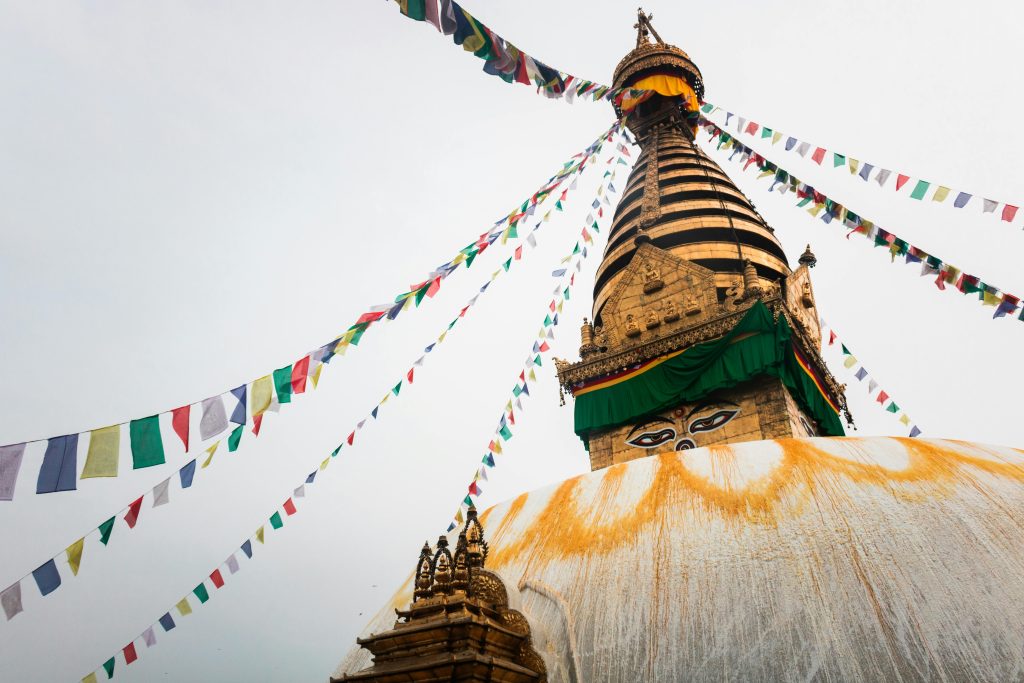
- UNESCO sites: Pashupatinath, Boudhan
Neighboring Countries of Nepal
Nepal shares land borders with the following countries: