Random Country Generator 🌎

Cambodia
🏙️ Capital city:
Phnom Penh
📈 Country population:
17 million
🗺️ Country area:
181,035 km²
Core Facts / Infobox
Present this as a clean two-column table containing accurate and verified national facts. Include only fields with real data.
| Official Name | Kingdom of Cambodia |
| Common Name | Cambodia |
| ISO Codes | KH, KHM, 116 |
| Internet TLD | .kh |
| Calling Code | +855 |
| Capital City | Phnom Penh |
| Largest City | Phnom Penh |
| Coordinates | 12.5° N, 104.9° E |
| Time Zone | UTC+7 |
| Population (2025 est.) | ~17 million |
| Area | 181,035 km² |
| Population Density | ~94 per km² |
| Languages | Khmer (official), minority languages |
| Currency | Cambodian Riel (KHR); USD widely used |
| Driving Side | Right |
| GDP (Nominal) | ~USD 33+ billion |
| GDP (PPP) | ~USD 90+ billion |
| GDP Per Capita | ~USD 2,000+ |
| GDP Growth | ~5–6% |
| HDI | 0.593 (Medium) |
| Literacy Rate | ~80–85% |
| Life Expectancy | ~70 years |
| Unemployment | ~1–2% (informal sector high) |
| Inflation | ~3–5% |
| Leaders | King & Prime Minister (names omitted for longevity) |
| Continent & Subregion | Asia — Southeast Asia |
| National Day | 9 November (Independence Day) |
| National Sport | Pradal Serey (kickboxing) |
| National Dish | Fish Amok |
| National Anthem | Nokor Reach |
Geography & Environment
- Cambodia is located in Southeast Asia, bordered by Thailand, Laos, Vietnam, and the Gulf of Thailand.
- It features lowlands, forests, mountains, and the Tonlé Sap Lake, the largest freshwater lake in Southeast Asia.
- The Mekong River flows through the country, supporting agriculture and fishing.
- Climate: tropical monsoon with wet (May–October) and dry (November–April) seasons.
- Best time to visit: November to February.
- National parks: Cardamom Mountains, Bokor National Park, Virachey National Park.
- Wildlife includes elephants, tigers (rare), gibbons, crocodiles, and unique bird species.
- Environmental challenges: deforestation, illegal logging, climate change impacts, water management issues.
- Unique features: Angkor region’s forests, Tonlé Sap’s reversing river flow phenomenon.
Demographics
- Total population: ~17 million.
- Median age: ~26 years.
- Urban vs rural: ~24% urban, ~76% rural.
- Ethnic groups: Khmer (majority), Vietnamese, Cham, Chinese, hill tribes.
- Religions: Buddhism (majority), Islam, Christianity, traditional beliefs.
- Literacy rate: ~80–85%.
- Major cities: Phnom Penh, Siem Reap, Battambang, Sihanoukville.
History
- Cambodia’s roots lie in the ancient Funan and Chenla kingdoms.
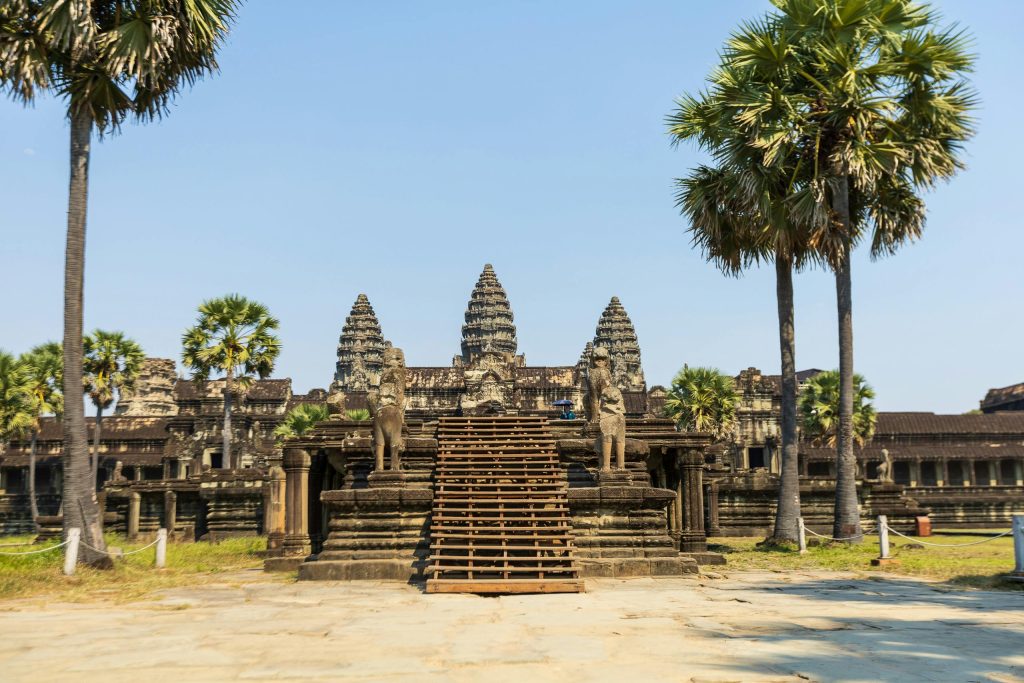
- The Khmer Empire (9th–15th century) built the iconic Angkor Wat and ruled much of mainland Southeast Asia.
- Colonial period: Cambodia became a French protectorate in 1863.
- Independence achieved on 9 November 1953.
- Dark period: Khmer Rouge regime (1975–1979) caused widespread tragedy.
- Modern Cambodia has focused on recovery, economic growth, and global integration.
Government & Politics
- Government type: Unitary constitutional monarchy.
- Executive: King (symbolic head of state) and Prime Minister.
- Legislature: bicameral Parliament (National Assembly and Senate).
- Judiciary: Supreme Court, appellate and provincial courts.
- Administrative divisions: 25 provinces including Phnom Penh.
- Political topics: development, infrastructure, foreign investment, governance reforms.
Economy
- Cambodia is one of Asia’s fastest-growing economies.
- Major industries: textiles and garments, tourism, agriculture, construction.
- Main exports: garments, footwear, rice, bicycles, furniture.
- Main imports: machinery, fuels, vehicles, refined textiles, chemicals.
- Strengths: tourism potential, low labor costs, strategic location.
- Weaknesses: limited infrastructure, reliance on garment industry, rural poverty.
- GDP sectors: Services (~40%), Industry (~34%), Agriculture (~22%).
- Tourism (especially Angkor Wat) is a major revenue source.
Culture & Society
- Khmer culture emphasizes family, respect, Buddhism, and community traditions.
- Major festivals: Khmer New Year, Pchum Ben, Water Festival, Royal Ploughing Ceremony.
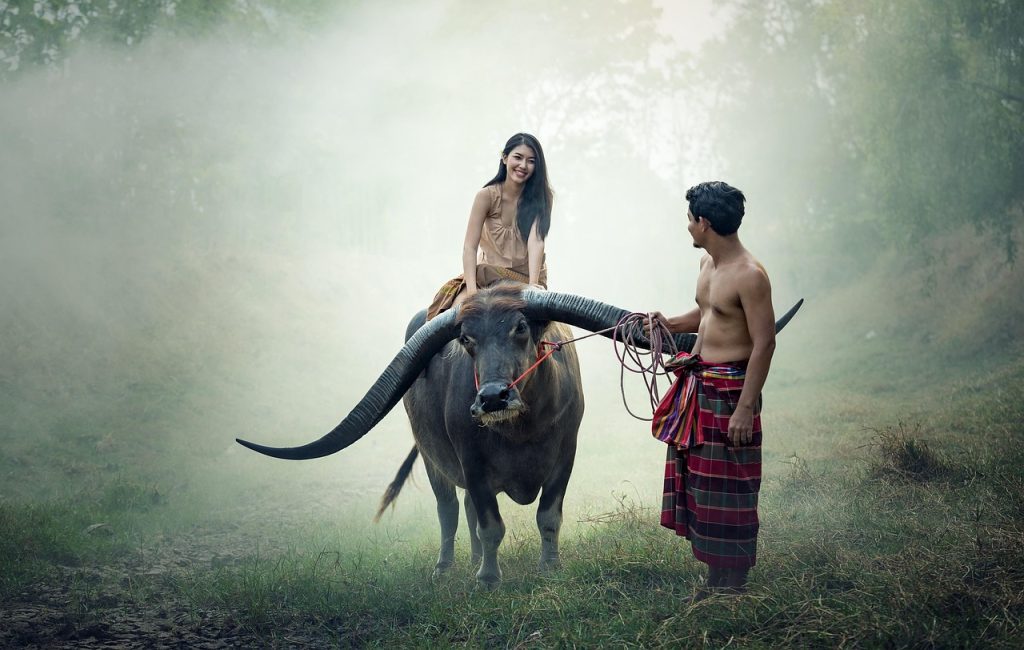
- Traditional dress: the Sampot for women and men in formal or cultural events.
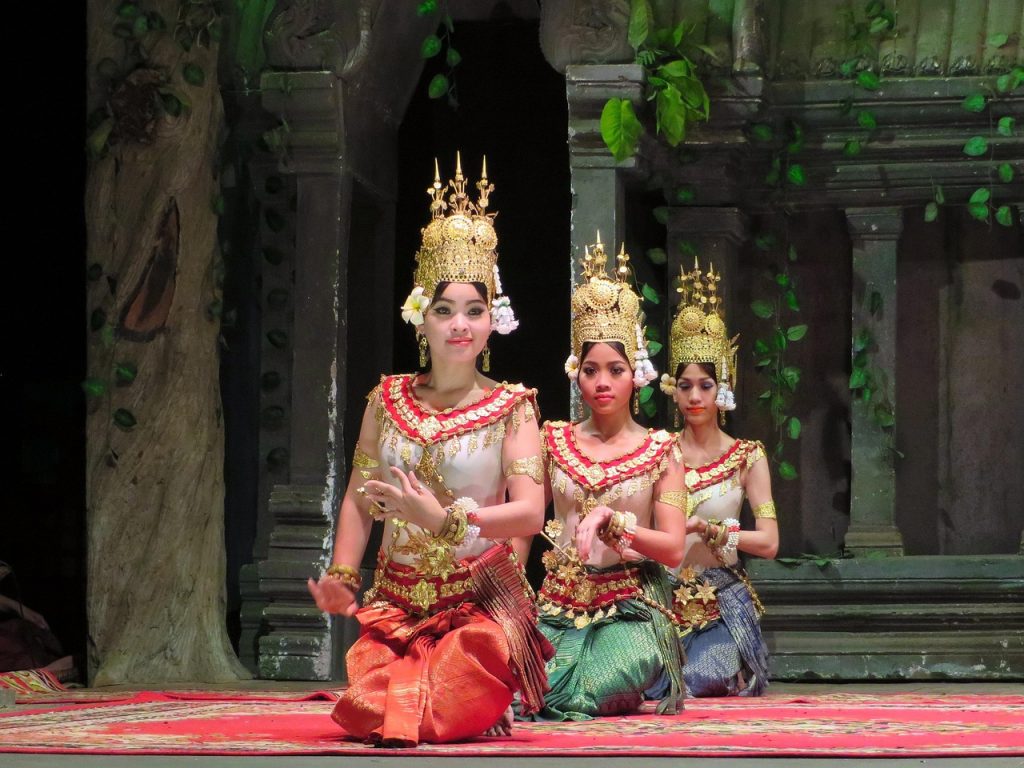
- Arts: Apsara dance, silk weaving, stone carving, classical music.
- Languages: Khmer (official), minority languages, English increasingly used in cities.
Food & Cuisine
- National dish: Fish Amok — a creamy coconut curry steamed in banana leaves.
- Iconic dishes: Lok Lak, Khmer Red Curry, Num Banh Chok (Khmer noodles), Bai Sach Chrouk.
- Street foods: grilled meats, noodle soups, fried insects, baguette sandwiches (num pang).
- Beverages: iced coffee with condensed milk, sugarcane juice, palm wine.
- Cuisine known for mild flavors, fresh herbs, fermented ingredients, and rice.
Education & Institutions
- Education improving steadily with growing enrollment rates.
- Medium of instruction: Khmer; English widely taught in higher education.
- Literacy rate: ~80–85%.
- Top universities: Royal University of Phnom Penh, University of Cambodia, Royal University of Law and Economics.
- Notable fields: agriculture, tourism, business, engineering.
Tourism
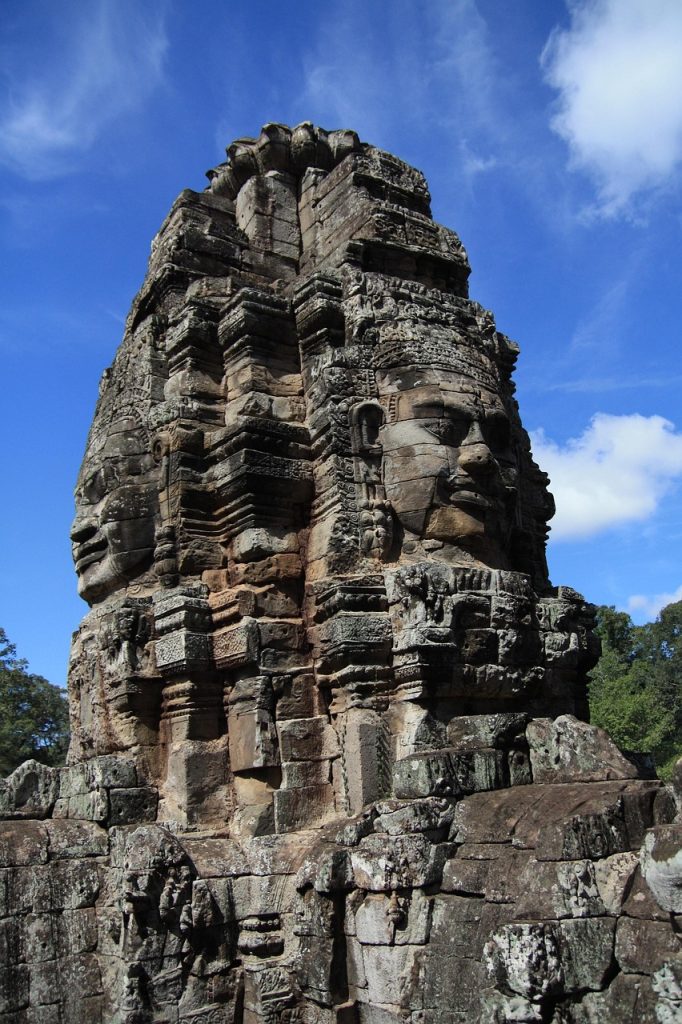
- Top attractions: Angkor Wat, Bayon Temple, Ta Prohm, Phnom Penh Royal Palace, Kampot, Sihanoukville beaches.
- UNESCO sites: Angkor, Temple of Preah Vihear.
- Natural attractions: Cardamom Mountains, Tonlé Sap Lake, Koh Rong Island.
- Historical landmarks: Killing Fields, Tuol Sleng Museum.
- Adventure tourism: trekking, kayaking, jungle exploration, island hopping.
- Visa: e-visa available for most visitors.
- Transportation: buses, tuk-tuks, ferries, domestic flights.
Practical Information
- Safety: generally safe; scams and petty theft occur in tourist areas.
- Healthcare: good in Phnom Penh; limited in rural areas.
- Emergency numbers: Police 117, Fire 118, Ambulance 119.
- Plug type: A, C, G; Voltage: 230V.
- Internet: good in major cities; 4G widespread.
- Best time to visit: November to February.
- Budget: very affordable for travelers.
Sports, Entertainment & Notable People
- National sport: Pradal Serey (Khmer kickboxing).
- Popular sports: football, volleyball, martial arts, dragon boat racing.
- Notable figures: Hun Sen (politics), Sinn Sisamouth (music), Angelina Jolie (honorary cultural advocate).
- Performing arts include Apsara dance and Khmer classical music.
Neighboring Countries of Cambodia
Cambodia shares land borders with the following countries:
Famous For
- Angkor Wat and Khmer Empire heritage.
- Fish Amok and traditional Khmer cuisine.
- Tonlé Sap Lake.
- Apsara dance.
- Beautiful islands like Koh Rong.
- French colonial architecture.
- Silk weaving and handicrafts.
Sources
- World Bank
- United Nations (UN Data)
- IMF
- CIA World Factbook
- Cambodia National Institute of Statistics
- Official Government Publications