Random Country Generator 🌎

Turkmenistan
🏙️ Capital city:
Ashgabat
📈 Country population:
6.3 million
🗺️ Country area:
491,210 km²
Core Facts / Infobox
Present this as a clean two-column table containing accurate and verified national facts. Include only fields with real data.
| Official Name | Turkmenistan |
| Common Name | Turkmenistan |
| ISO Codes | TM, TKM, 795 |
| Internet TLD | .tm |
| Calling Code | +993 |
| Capital City | Ashgabat |
| Largest City | Ashgabat |
| Coordinates | 38.9° N, 59.5° E |
| Time Zone | UTC+5 |
| Population (2025 est.) | ~6.3 million |
| Area | 491,210 km² |
| Population Density | ~13 per km² |
| Languages | Turkmen (official), Russian widely understood |
| Currency | Turkmenistan Manat (TMT) |
| Driving Side | Right |
| GDP (Nominal) | ~USD 30+ billion |
| GDP (PPP) | ~USD 120+ billion |
| GDP Per Capita | ~USD 5,000+ |
| GDP Growth | ~6–7% |
| HDI | 0.715 (High) |
| Literacy Rate | ~99% |
| Life Expectancy | ~68 years |
| Unemployment | ~4–5% (unofficial rates higher) |
| Inflation | ~10–15% (estimated) |
| Leaders | President & Cabinet (names omitted for longevity) |
| Continent & Subregion | Asia — Central Asia |
| National Day | 27 October |
| National Sport | Horse riding & traditional equestrian sports |
| National Dish | Plov |
| National Anthem | Garaşsyz Bitarap Türkmenistanyň Döwlet Gimni |
Geography & Environment
- Turkmenistan is located in Central Asia, bordered by Kazakhstan, Uzbekistan, Afghanistan, Iran, and the Caspian Sea.
- The country is dominated by the vast Karakum Desert, which covers nearly 70% of the territory.
- The Kopet Dag mountains run along the southern border with Iran.
- Major water sources include the Amu Darya River and the Karakum Canal.
- Climate: extremely arid desert climate with hot summers and mild winters.
- Best time to visit: April–June and September–October.
- National parks: Köýtendag Nature Reserve, Repetek Biosphere Reserve.
- Wildlife includes gazelles, wild sheep, desert foxes, and rare reptile species.
- Environmental challenges: water scarcity, desertification, salinization, Caspian Sea decline.
- Unique features: Darvaza Gas Crater (“Door to Hell”), white marble architecture of Ashgabat.
Demographics
- Total population: ~6.3 million.
- Median age: ~27 years.
- Urban vs rural: ~52% urban and ~48% rural.
- Ethnic groups: Turkmen majority, with Uzbek, Russian, and Kazakh minorities.
- Religions: Islam (majority Sunni), with small Christian communities.
- Literacy rate: ~99%.
- Major cities: Ashgabat, Turkmenabat, Dashoguz, Mary, Balkanabat.
History
- Turkmenistan’s history includes ancient civilizations such as Margiana and Parthia.
- Later influenced by Turkic migrations, Persian empires, and the Silk Road trade routes.
- Became part of the Russian Empire in the 19th century and later a Soviet republic.
- Gained independence from the USSR on 27 October 1991.
- Modern history shaped by strong state control, energy development, and neutrality in foreign policy.
Government & Politics
- Government type: Unitary presidential republic with centralized authority.
- Executive: President as head of state and government.
- Legislature: bicameral National Council.
- Judiciary: Supreme Court and lower courts.
- Administrative divisions: 5 provinces (welayats) and the capital city.
- Foreign policy emphasizes neutrality and limited political engagement.
Economy
- The economy is heavily dependent on natural gas, with Turkmenistan holding some of the world’s largest reserves.
- Major industries: natural gas, oil, cotton, textiles, chemicals, construction.
- Main exports: natural gas, oil, cotton fiber, textiles, electricity.
- Main imports: machinery, vehicles, food products, equipment.
- Strengths: abundant energy resources, strategic location.
- Weaknesses: lack of diversification, state-controlled economy, limited foreign investment.
- GDP sectors: Industry (~35%), Services (~45%), Agriculture (~20%).
- Large infrastructure projects dominate government spending.
Culture & Society
- Turkmen culture blends Turkic, Persian, and nomadic traditions.
- Values emphasize hospitality, family unity, and tribal heritage.
- Important festivals: Nowruz, Independence Day, Flag Day.
- Traditional dress includes embroidered robes and telpek hats.
- Arts: Turkmen carpets (UNESCO heritage), equestrian shows, folk music.
- Language: Turkmen (official), Russian commonly used in cities.
Food & Cuisine
- National dish: Plov (Pilaf) — rice cooked with lamb, carrots, and spices.
- Popular dishes: Shorpa (meat soup), Manti (dumplings), Ichlekli (meat pie).
- Street foods: kebabs, flatbreads, samsa.
- Desserts: dried fruits, halva, sweet pastries.
- Beverages: green tea, ayran, local dairy drinks.
- Cuisine is hearty, meat-based, and influenced by nomadic traditions.
Education & Institutions
- Education system is centralized and government-managed.
- Medium of instruction: Turkmen, with Russian used in some schools.
- Literacy rate: ~99%.
- Top universities: Turkmen State University, International University of Humanities and Development.
- Key fields: engineering, agriculture, language studies.
Tourism
- Top attractions: Darvaza Gas Crater, White Marble City of Ashgabat, ancient Merv (UNESCO), Nisa ruins, Yangykala Canyon.
- UNESCO sites: Ancient Merv, Kunya-Urgench, Nisa.
- Natural attractions: Karakum Desert, Kopet Dag mountains, Caspian Sea coastline.
- Historical landmarks: Silk Road ruins, medieval forts, mausoleums.
- Adventure tourism: desert camping, trekking, horseback tours.
- Visa: often requires invitation; strict entry rules.
- Transportation: limited domestic flights, buses, private taxis.
Practical Information
- Safety: generally safe with low crime; travel restrictions apply.
- Healthcare: limited outside major cities.
- Emergency numbers: Police 02, Ambulance 03, Fire 01.
- Plug type: C & F; Voltage: 220V.
- Internet: limited access; speeds vary.
- Best time to visit: spring and autumn.
- Budget: moderate; transportation and accommodation vary in price.
Sports, Entertainment & Notable People
- National activities: horse riding and traditional equestrian sports.
- Popular sports: football, wrestling, weightlifting, martial arts.
- Turkmen horses (Akhal-Teke) are world-famous.
- Cultural icons include poets, musicians, and traditional storytellers.
Neighboring Countries of Turkmenistan
Turkmenistan shares land borders with the following countries:
- 744 km with Afghanistan
- 992 km with Iran
- 379 km with Kazakhstan
- 1,621 km with Uzbekistan
Famous For
- Darvaza Gas Crater (“Door to Hell”).
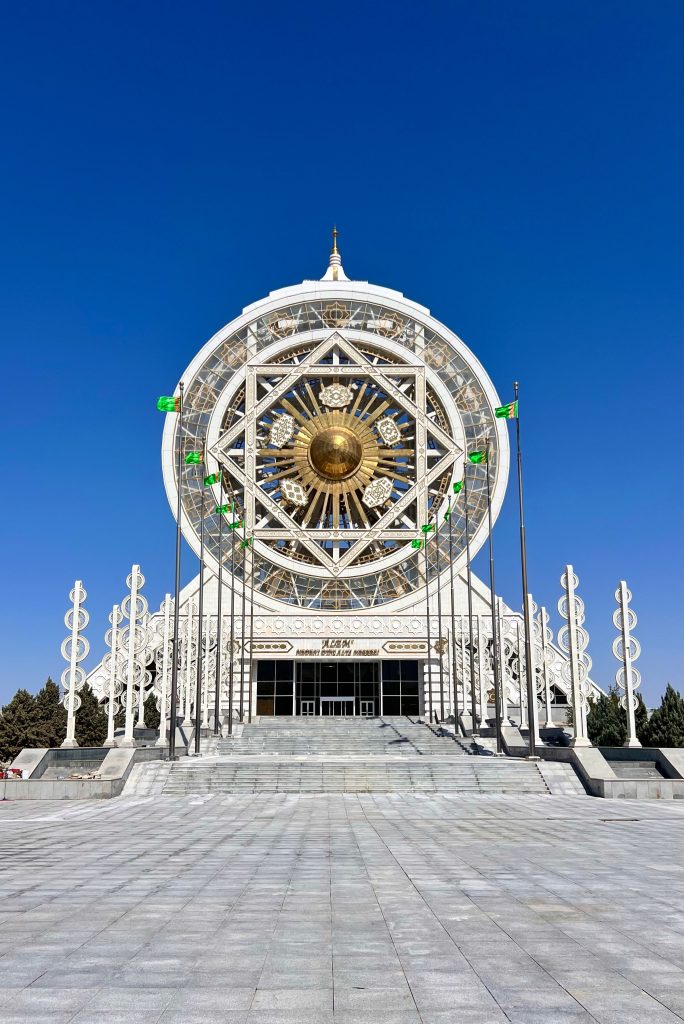
- White marble architecture of Ashgabat.
- Akhal-Teke horses.
- Silk Road history and UNESCO sites.
- Karakum Desert landscapes.
- Traditional Turkmen carpets.
- Rich nomadic culture.
Sources
- World Bank
- United Nations (UN Data)
- IMF
- CIA World Factbook
- Turkmenistan State Committee of Statistics
- Official Government Publications