Random Country Generator 🌎
Oman
🏙️ Capital city:
Muscat
📈 Country population:
5.4 million
🗺️ Country area:
309,500 km²
Core Facts / Infobox
Present this as a clean two-column table containing accurate and verified national facts. Include only fields with real data.
| Official Name | Sultanate of Oman |
| Common Name | Oman |
| ISO Codes | OM, OMN, 512 |
| Internet TLD | .om |
| Calling Code | +968 |
| Capital City | Muscat |
| Largest City | Muscat |
| Coordinates | 23.6° N, 58.6° E |
| Time Zone | UTC+4 |
| Population (2025 est.) | ~5.4 million |
| Area | 309,500 km² |
| Population Density | ~17 per km² |
| Languages | Arabic (official), English widely used |
| Currency | Omani Rial (OMR) |
| Driving Side | Right |
| GDP (Nominal) | ~USD 130+ billion |
| GDP (PPP) | ~USD 240+ billion |
| GDP Per Capita | ~USD 23,000+ |
| GDP Growth | ~2–3% |
| HDI | 0.816 (Very High) |
| Literacy Rate | ~97% |
| Life Expectancy | ~78 years |
| Unemployment | ~3–4% |
| Inflation | ~1–2% |
| Leaders | Sultan & Cabinet (names omitted for longevity) |
| Continent & Subregion | Asia — Middle East (Arabian Peninsula) |
| National Day | 18 November |
| National Sport | Horse Racing & Camel Racing |
| National Dish | Shuwa |
| National Anthem | Nashid as-Salaam as-Sultani |
Geography & Environment
- Oman is located on the southeastern Arabian Peninsula, sharing borders with the UAE, Saudi Arabia, and Yemen, with coastlines along the Arabian Sea and Gulf of Oman.
- Geographical features include vast deserts, rugged mountains, fertile coastal plains, and fjord-like inlets in Musandam.
- The Al Hajar Mountains dominate northern Oman, while the Empty Quarter desert covers the southwest.
- Climate: hot desert climate with extremely hot summers and mild winters.
- Best time to visit: October to April.
- Major natural reserves: Ras Al Jinz Turtle Reserve, Jebel Akhdar, Wahiba Sands.
- Wildlife includes Arabian oryx, gazelles, sea turtles, and diverse marine species.
- Environmental challenges: water scarcity, desertification, coastal erosion.
- Unique features: Musandam fjords, Frankincense trees of Dhofar (UNESCO), and dramatic mountain wadis.
Demographics
- Total population: ~5.4 million.
- Median age: ~31 years.
- Urban vs rural: ~86% urban.
- Ethnic groups: Omani Arabs majority, with expatriate communities from South Asia, Africa, and the Middle East.
- Religions: Islam (majority Ibadi), with Sunni and Shia minorities.
- Literacy rate: ~97%.
- Major cities: Muscat, Salalah, Sohar, Nizwa, Sur.
History
- Oman’s history dates back to ancient civilizations tied to maritime trade and frankincense production.
- Ruled by various Arab tribes, influenced by Persian and Portuguese occupation.
- Portuguese control ended in the 17th century when Oman became a naval power.
- In the 19th century, Oman established a trading empire reaching East Africa.
- Modern Oman was unified under the Al Said dynasty.
- Major reforms began in the 1970s, modernizing infrastructure, economy, and education.
- Current era emphasizes Vision 2040 development plans.
Government & Politics
- Government type: Unitary absolute monarchy.
- Executive: Sultan as head of state and government.
- Legislature: bicameral (Council of State and Consultative Council).
- Judiciary: Supreme Court and lower courts.
- Administrative divisions: 11 governorates.
- Foreign policy: neutrality, diplomacy, regional stability.
Economy
- Oman’s economy is diversified but still dependent on oil and gas revenues.
- Major industries: oil & gas, tourism, logistics, mining, fisheries, agriculture.
- Main exports: crude oil, natural gas, petrochemicals, dates, fisheries.
- Main imports: machinery, vehicles, electrical equipment, food, manufactured goods.
- Strengths: strategic shipping location, political stability, tourism potential.
- Weaknesses: reliance on hydrocarbons, water scarcity.
- GDP sectors: Services (~60%), Industry (~38%), Agriculture (~2%).
- Economic reforms align with Oman Vision 2040.
Culture & Society
- Omani culture is rooted in Arab, maritime, and East African influences.
- Values emphasize hospitality, respect, and community.
- Major festivals: National Day, Eid al-Fitr, Eid al-Adha, Khareef Festival in Salalah.
- Traditional dress includes the dishdasha for men and colorful dresses for women.
- Arts include dhow-building, pottery, weaving, and traditional Omani music.
- Languages: Arabic (official) with English commonly spoken.
Food & Cuisine
- National dish: Shuwa — slow-cooked spiced lamb wrapped in palm leaves.
- Popular dishes: Majboos, Harees, Mishkak, Halwa.
- Street foods: shawarma, samosas, grilled seafood.
- Desserts: Omani halwa, dates, honey pastries.
- Beverages: Kahwa (Omani coffee with cardamom), laban, tea.
- Omani cuisine is influenced by Indian, Persian, and East African flavors.
Education & Institutions
- Modern education system established in the 1970s.
- Medium of instruction: Arabic, with English widely used in higher education.
- Literacy rate: ~97%.
- Top universities: Sultan Qaboos University, University of Nizwa, Dhofar University.
- Key fields: engineering, business, medicine, maritime studies.
Tourism
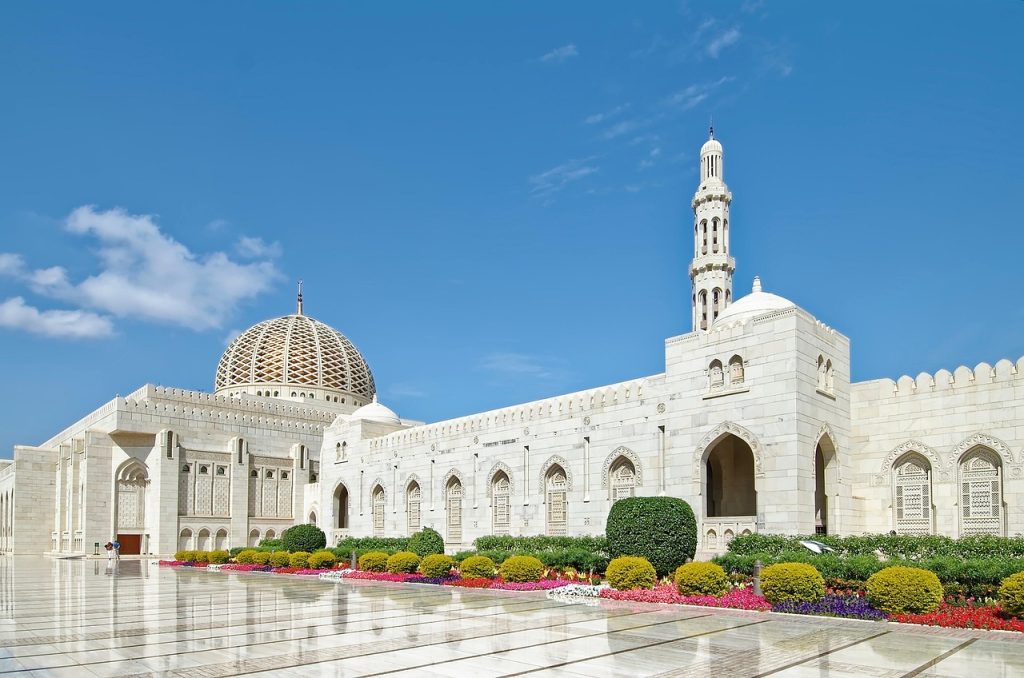
- Top attractions: Sultan Qaboos Grand Mosque, Mutrah Corniche, Jebel Akhdar, Wahiba Sands, Nizwa Fort, Salalah.
- UNESCO sites: Bahla Fort, Land of Frankincense in Dhofar, Bat Tombs.
- Natural attractions: wadis, mountains, deserts, pristine beaches.
- Historical landmarks: forts, souqs, ancient settlements.
- Adventure tourism: hiking, diving, desert safaris, mountain climbing.
- Visa: eVisa available for many nationalities.
- Transportation: modern road network, domestic flights, taxis, buses.
Practical Information
- Safety: extremely safe with low crime rates.
- Healthcare: modern facilities in main cities.
- Emergency numbers: Police 9999, Ambulance 9999, Fire 9999.
- Plug type: G; Voltage: 240V.
- Internet: good 4G/5G coverage.
- Best time to visit: October–April.
- Budget: moderate to high, depending on travel style.
Sports, Entertainment & Notable People
- National sports: camel racing and horse racing.
- Popular sports: football, athletics, sailing.
- Oman participates in regional Gulf sports competitions.
- Cultural icons include poets, musicians, seafarers, and traditional dhow builders.
Neighboring Countries of Oman
Oman shares land borders with the following countries:
- 676 km with Saudi Arabia
- 410 km with United Arab Emirates
- 288 km with Yemen
Famous For
- Frankincense and ancient trade routes.
- Wahiba Sands desert.
- Musandam fjords.
- Pristine beaches & marine life.
- Grand forts and castles.
- Khareef monsoon season in Salalah.
- Traditional Omani hospitality.
Sources
- World Bank
- United Nations (UN Data)
- IMF
- CIA World Factbook
- National Centre for Statistics & Information (Oman)
- Official Government Publications