
Random Country Generator 🌎
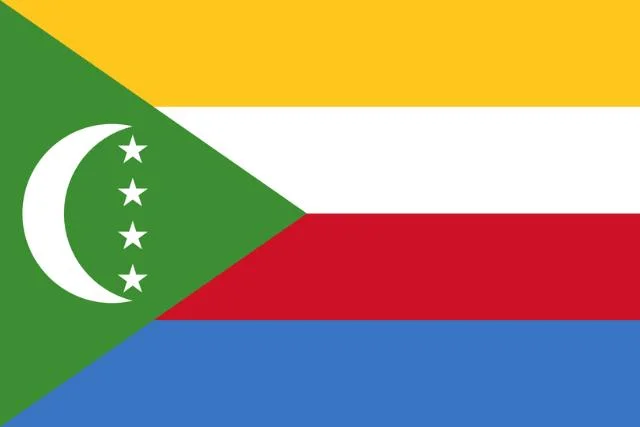
Comoros
🏙️ Capital city:
Moroni
📈 Country population:
900,000
🗺️ Country area:
2,235 km²
Core Facts / Infobox
Present this as a clean two-column table containing accurate and verified national facts. Include only fields with real data.
| Official Name | Union of the Comoros |
| Common Name | Comoros |
| Political Status | Sovereign federal presidential republic |
| ISO Codes | KM, COM, 174 |
| Internet TLD | .km |
| Calling Code | +269 |
| Capital City | Moroni |
| Largest City | Moroni |
| Coordinates | 11.70° S, 43.25° E |
| Time Zone | UTC+3 (East Africa Time) |
| Population (2025 est.) | ~900,000 |
| Area | 2,235 km² |
| Population Density | ~400 per km² |
| Languages | Comorian (Shikomori), Arabic, French (official) |
| Currency | Comorian Franc (KMF) |
| Driving Side | Right |
| GDP (Nominal) | ~USD 1.4 billion |
| GDP Per Capita | ~USD 1,600 |
| HDI | Low |
| Life Expectancy | ~65 years |
| Continent & Subregion | Africa — East Africa (Indian Ocean) |
| National Day | Independence Day (6 July) |
| National Anthem | Udzima wa ya Masiwa |
Geography & Environment
- Island nation in the Indian Ocean between Madagascar and Mozambique.
- Composed of three main islands: Grande Comore, Mohéli, and Anjouan.
- Volcanic origin; Mount Karthala is an active volcano.
- Coastal plains, coral reefs, and mountainous interiors.
- Climate: tropical maritime with a cyclone season.
Demographics
- Population: ~900,000.
- Ethnically mixed population with African, Arab, and Malagasy roots.
- High population density and youthful population.
- Religion: Islam (Sunni, overwhelming majority).
History
- Historically influenced by Arab traders and Swahili culture.
- Colonized by France in the 19th century.
- Gained independence in 1975 (excluding Mayotte).
- Experienced frequent coups after independence.
- Recent decades marked by relative political stabilization.
Government & Politics
- Political system: Federal presidential republic.
- Head of State & Government: President.
- Rotating presidency historically among islands.
- Legislature: unicameral Assembly of the Union.
Economy
- Low-income, fragile economy.
- Key sectors: agriculture, fishing, services.
- Main exports: vanilla, cloves, ylang-ylang.
- Strengths: strategic location, cash crops.
- Weaknesses: limited land, unemployment, reliance on remittances.
Culture & Society
- Strong Swahili-Islamic cultural identity.
- Traditional customs play a central role in social life.
- Community ceremonies and extended family structures important.
Food & Cuisine
- Staple foods: rice, cassava, fish.
- Traditional dishes: langouste, pilao, coconut-based stews.
- Heavy use of spices and coconut milk.
Education & Institutions
- Education access improving but limited.
- Major institution: University of the Comoros.
Tourism
- Small and underdeveloped tourism sector.
- Attractions include beaches, coral reefs, and volcanic landscapes.
- Potential for eco- and marine tourism.
Practical Information
- Emergency services limited.
- Plug type: C/E; Voltage: 220V.
- Infrastructure concentrated around Moroni.
Sports, Entertainment & Notable People
- Popular sport: football.
- Traditional music and dance widely practiced.
- Notable figures: Ahmed Abdallah Mohamed Sambi.
Neighboring Countries of Comoros
Comoros is an archipelagic nation in the Indian Ocean. It does not share any land borders. Its closest neighboring countries are
Mozambique to the west,
Tanzania to the northwest, and
Madagascar to the east.
The French overseas department of Mayotte lies immediately to the southeast.
Famous For
- Ylang-ylang production.
- Volcanic islands.
- Swahili-Islamic culture.
- Indian Ocean biodiversity.
Sources
- World Bank
- United Nations (UN Data)
- IMF
- CIA World Factbook
- National Institute of Statistics (Comoros)